Glacier National Park Information Page

Welcome to the Glacier National Park Information Page.
Here you will find all you need to know about the natural history of the park.
Learn about the geology, trees, mammals, birds, or other plants and wildlife of the area.

-SPONSORED LINKS-
Glacier National Park Lodging
Glacier National Park Hotels
Glacier National Park Maps
Glacier National Park Camping
Montana Weather
Glacier National Park Tours
Glacier National Park Pictures
Glacier National Park Vacation
Moose

Sponsored National Park Search

Moose - Corel ©

Glacier National Park Information

  • Establishment
  • General Info
  • Geology
  • History
  • Mammal List
  • Size & Visitation
  • Wildflowers
  • Wildlife

  • 
    

    Establishing the Park

    Around the turn of the century, people started to look at the land differently. Rather than just seeing the minerals they could mine or land to settle on, they started to recognize the value of its spectacular scenic beauty. Facilities for tourists started to spring up. In the late 1890's, visitors arriving at Belton (now called West Glacier) could get off the train, take a stagecoach ride a few miles to Lake McDonald, and then board a boat for an eight mile trip to the Snyder Hotel. No roads existed in the mountains, but the lakes allowed boat travel into the wilderness.

    Soon people, like George Bird Grinnell, pushed for the creation of a national park. Grinnell was an early explorer to this part of Montana and spent many years working to get the park established. The area was made a Forest Preserve in 1900, but was open to mining and homesteading. Grinnell and others sought the added protection a national park would provide. Grinnell saw his efforts rewarded in 1910 when President Taft signed the bill establishing Glacier as the country's 10th national park.


    Size and Visitation

    The park encompasses approximately 1.4 million acres of wilderness and some of the most beautiful mountain scenery in the western United States. A combination of spectacular scenery, diverse flora and fauna, and relative isolation from major population centers have combined to make Glacier National Park the center of one of the largest and most intact ecosystems in North America.

    Glacier National Park is open year round, but due to it's northern mountainous location, most people visit the park in the spring and summer. Park services open in late May and continue through September. During other months, limited service is available inside the park, and all services are available outside the park in local communities. You can visit without the crowds in the off season months. The peak visitor season is in June through September.


    General Information

    Glacier National Park was established to protect the area's spectacular scenic values, as characterized by the geologic features of the Rocky Mountains and valleys and the native plant and animal life. The park encompasses approximately 1.4 million acres of wilderness and some of the most beautiful mountain scenery in the western United States. A combination of spectacular scenery, diverse flora and fauna, and relative isolation from major population centers have combined to make Glacier National Park the center of one of the largest and most intact ecosystems in North America.

    The general park area was once the homeland of the Blackfoot and Kootenai Indian tribes and many sites in the park are sacred spiritual sites.

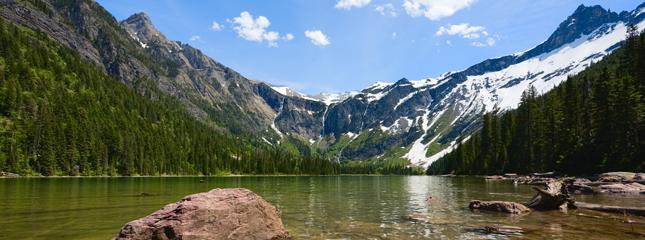
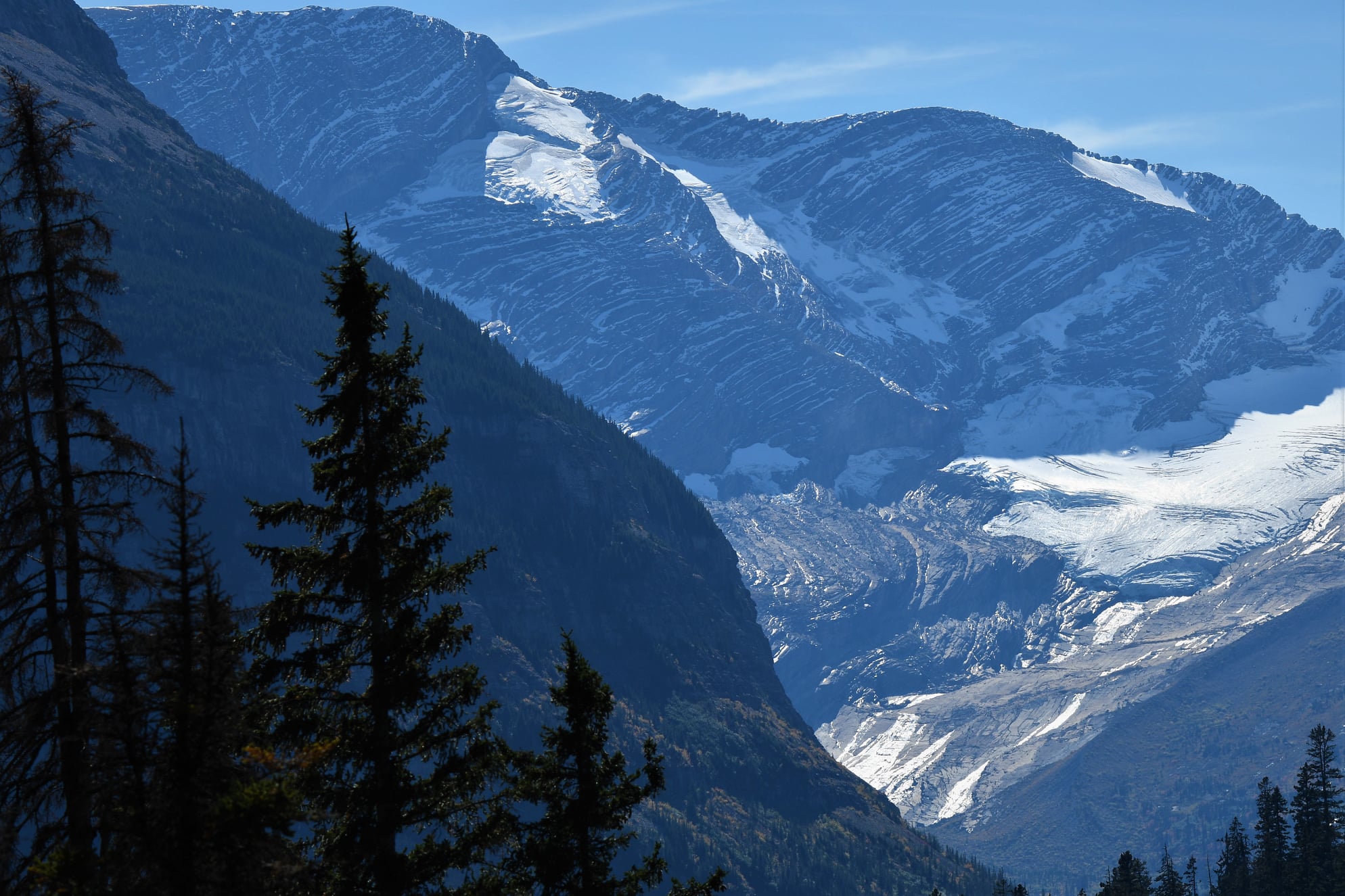
    There are over 50 glaciers in the park from which it gets its name. There are also over 200 lakes or streams in Glacier.

    There are over 730 miles of trails for hikers to enjoy in Glacier National Park.

    The park is traversed from east to west by Going-to-the-Sun Road. A specular drive! For visitors who wish to drive through the park, the Going-to-the-Sun Road is an experience to remember. Bisecting the heart of Glacier, this 50 mile long road follows the shores of the park's two largest lakes and hugs the cliffs below the Continental Divide as it traverses Logan Pass. Numerous scenic turnouts and wayside exhibits allow travelers to stop and enjoy the park at their own pace.

    There are size restrictions for vehicles driving the Going-to-the-Sun Road. Vehicles longer than 21 feet or wider than 8 feet (including mirrors) are prohibited on the steepest sections of the road.

    Public showers are available at Many Glacier and Rising Sun.

    Going-to-the-Sun Road History

    After the creation of the park, the growing staff of park rangers needed housing and offices to help protect the new park. The increasing number of park visitors made the need for roads, trails, and hotels urgent. The Great Northern Railway built a series of hotels and small backcountry lodges, called chalets, throughout the park. A typical visit to Glacier involved a train ride to the park, followed by a multi-day journey on horseback. Each day after a long ride in the mountains, guests would stay at a different hotel or chalet. The lack of roads meant that, to see the interior of the park, visitors had to hike or ride a horse. Eventually, the demand for a road across the mountains led to the building of the Going-to-the-Sun Road.

    The construction of the Going-to-the-Sun Road was a huge undertaking. Even today, visitors to the park marvel at how such a road could have been built. The final section of the Going-to-the-Sun Road, over Logan Pass, was completed in 1932 after 11 years of work. The road is considered an engineering feat and is a National Historic Landmark. It is one of the most scenic roads in North America. The construction of the road forever changed the way visitors would experience Glacier National Park. Future visitors would drive over sections of the park that previously had taken days of horseback riding to see.

    Just across the border, in Canada, is Waterton Lakes National Park. In 1931, members of the Rotary Clubs of Alberta and Montana suggested joining the two parks as a symbol of the peace and friendship between our two countries. In 1932, the United States and Canadian governments voted to designate the parks as Waterton-Glacier International Peace Park, the world's first. More recently the parks have received two other international honors. The parks are both Biosphere Reserves, and were named as a World Heritage Site in 1995. This international recognition highlights the importance of this area, not just to the United States and Canada, but to the entire world.

    While much has changed since the first visitors came to Glacier, it is possible to relive some of Glacier�s early history. You can take a horseback ride like an early visitor. Miles of hiking trails follow routes first used by trappers in the early 1800's. Several hotels and chalets, built by the Great Northern Railway in the early 1900's, house summer guests to the park. A visit to Glacier National Park is still a great adventure!


    History

    Recent archaeological surveys have found evidence of human use dating back over 10,000 years. These people may have been the ancestors of tribes that live in the area today. By the time the first European explorers came to this region, several different tribes inhabited the area. The Blackfeet Indians controlled the vast prairies east of the mountains. The Salish and Kootenai Indians lived and hunted in the western valleys. They also traveled east of the mountains to hunt buffalo.

    In the early 1800�s, French, English, and Spanish trappers came in search of beaver. In 1806, the Lewis and Clark Expedition came within 50 miles of the area that is now the park.

    As the number of people moving west steadily increased, the Blackfeet, Salish, and Kootenai were forced onto reservations. The Blackfeet Reservation adjoins the east side of the park. The Salish and Kootenai reservation is southwest of Glacier. This entire area holds great spiritual importance to the Blackfeet, Salish, and Kootenai people.

    The railroad over Marias Pass was completed in 1891. The completion of the Great Northern Railway allowed more people to enter the area. Homesteaders settled in the valleys west of Marias Pass and soon small towns developed.

    Under pressure from miners, the mountains east of the Continental Divide were acquired in 1895 from the Blackfeet. Miners came searching for copper and gold. They hoped to strike it rich, but no large copper or gold deposits were ever located. Although the mining boom lasted only a few years, abandoned mine shafts are still found in several places in the park.

    A Park Bridging Two Nations

    Glacier National Park is a land of high-mountain adventure, a land that sets the senses soaring and the spirits winging. Here you'll find lofty mountain ranges with sculptured glacial valleys, ice cold lakes that mirror mountains and sky, wildflowers and wildlife flourishing in alpine meadows and prairie grasslands. These exquisite elements make up Waterton Lakes National Park in Canada and the adjoining Glacier National Park in the United States. But there is more. To commemorate the long history of peace and friendship between our two nations, Waterton and Glacier have been designated the Waterton/Glacier International Peace Park.

    Though administered by separate countries and divided by the international boundary, the parks are at the same time united in the most natural of ways. Glaciers carved the Upper Waterton Valley, which lies in both nations; the native plants and animals are similar; and the massive Rocky Mountains span the two countries. Long before European explorers and settlers began to venture into the Rockies, the peoples native to this region shared the boundaries of the land and considered it one.

    In the mid 18th century things began to change. The quest for furs drew trappers deep into these mountains, and boundaries were drawn, making the domains of the great fur-trading companies of the west. Then in 1818, the 49th parallel to the Continental Divide was established as the international boundary between the territory of the United States and what was then territory owned by Great Britain, arbitrarily dividing the natural land area of today's Waterton/Glacier. In the late 19th century, farsighted men such as Frederick William Godsal in Canada and George Bird Grinnell in the United States labored to persuade their governments to set aside parts of the Rockies as wilderness recreational havens to be preserved for future generations. Their goals were reached in 1895 when Waterton Lakes National Park was established and in 1910 when Glacier was created. As the years went by, people in both nations recognized the natural unity of the parks, and largely through the efforts of Rotary International of Alberta and Montana, the US Congress and the Canadian Parliament in 1932 established the first international peace park - Waterton/Glacier International Peace Park. The park symbolizes the bonds of peace and friendship between the people of the United States and Canada. Through the United Nations Education and Scientific Organization's Man and Biosphere Program, Waterton Lakes and Glacier national parks have been designated as Biosphere Reserves. This program explores the relationships between people and the many ecosystems of the world. Biosphere Reserves provides for scientific research, education, and the preservation of biologic and genetic diversity. In 1995 the parks were designated Waterton/Glacier International Peace Park World Heritage Site.


    Geology

    Today's towering mountains, exquisite wildflowers, and diverse wildlife are three different aspects of Glacier National Park. The mountains began as sediments deposited in an ancient sea and slowly hardened into thick layers of limestone, mudstone, and sandstone. About 60 million years ago, tensions building within the Earth's crust could no longer be contained, and the rock layers began to warp, fold and finally break. A huge slab of rock moved from the west and began to slide up and over the softer rock of eastern ranges. Eventually a 300-mile-long portion of the crust had been thrust more than 50 miles to the east. Throughout the world similar processes created other mountain systems, but few can rival the Lewis Overthrust of Waterton/Glacier.

    The Lewis Overthrust of Waterton/Glacier provides scientists with insight about the massive dynamics of geologic processes that are going on today in other parts of the world, such as the Andes and the Himalaya Mountains. Because of the high degree of preservation of the original rock characteristics, the recent glacial sculpturing of the rocks, and the access by roads and trails, this major geologic structure in Waterton/Glacier Park is available for study by scientists from around the world.

    The Lewis Overthrust began 170 million years ago, when a collision of the Earth s crustal plates elevated numerous mountain chains and formed the ancestral Rocky Mountains. Ever-increasing stresses near the end of this great event shoved a huge rock wedge, several miles thick and several hundred miles wide, eastward more than 50 miles. Large masses of relatively stronger rocks were shoved over softer and more easily deformed rocks. Erosion stripped away the upper part of the original rock wedge and exposed the rocks and structures visible in the park today. Rarely have rocks of such ancient age been thrust over rocks that are so much younger. The overlying Proterozoic rocks are over 1,500 million years older than the underlying Cretaceous age rocks. Thus, the Lewis Overthrust is significant as a structural feature, for the extent of lateral displacement (up to 80 kilometers), and because it has functioned to expose ancient sediments possessing an unparalleled degree of preservation. Of particular scenic and geologic note is Chief Mountain, a spectacular monolith towering above the prairie along the eastern margin of Glacier. Chief Mountain is an erosionally isolated remnant of the eastern edge of the upper plate of the Lewis Overthrust � a feature known as a Klippen ranking with the Matterhorn as an example of this structural and erosional phenomenon.

    Proterozoic Sedimentary Rocks

    Most of the rocks exposed in the park are sedimentary rocks of Proterozoic age, which were deposited from 1,600 to 800 million years ago. Rocks of that age in other parts of the world have been greatly altered by mountain building processes and no longer exhibit their original characteristics. These virtually unaltered Proterozoic rocks of Waterton/Glacier are unique in that they have preserved the subtle features of sedimentation such as ripple marks, mud cracks, salt-crystal casts, raindrop impressions, oolites, six species of fossil algae, mudchip breccias, and many other bedding characteristics. These Proterozoic sedimentary rocks, while outcropping over an area extending from southern Montana to southern British Columbia, are most impressively exposed in Glacier. Due to the extreme relief and unexcelled exposures, over 2,100 meters of stratigraphic thickness is exposed to scientific examination. These features plus their chemical characteristics make the Proterozoic sediments of Glacier and Waterton National Parks unique for studying the physical and chemical conditions that existed on the Earth over a billion years ago. Such information is of great importance to scientists in understanding the stability or changes of the Earth's climates through geologic time. The recent glacial carving of these rocks has left them unusually fresh and beautifully exposed.

    Stromatolites

    Several of the sedimentary rock layers described above, contain fossils called stromatolites. They were colonial organisms of blue-green algae that lived in warm shallow seas marginal to ancient lands. Six species representing three genera of stromatolites are preserved in the ancient sediments of the park. Because of the high degree of preservation of the rocks in which these fossils occur, the stromatolites of Waterton/Glacier contain such detail as to make them unique. Paleontologists from around the world come to Waterton/Glacier to study these fossils because of their preservation, diversity, and antiquity. These fossils are a major source of information concerning the physical and chemical conditions on the Earth for a time period of about 800 million years, at a time over a billion years ago. A professional geologist for the United States Geological Survey recently compared these ancient rocks and fossils of Glacier to the rare book section of the world's geological library.

    Glaciers

    Once the mountains were in place, wind, water, and glaciers went to work on the raw landscape. Glaciers shaped and carved the land, cutting deep U-shaped valleys. Smaller tributary glaciers created hanging valleys. Today abundant waterfalls plunge these hanging valleys to lower elevations. While glaciers are no longer found in Waterton Lakes National Park, glaciers are still at work in the high country of Glacier National Park.

    What is a Glacier?

    A glacier forms when more snow falls each winter than melts the next summer. The accumulation of snow above presses down on the layers below, and compacts them into ice. Ice near the surface of the glacier is often hard and brittle but, due to the pressure of ice above, the ice near the bottom of the glacier becomes flexible. This flexible layer allows the ice to move. Depending on the amount of ice, the angle of the mountainside, and the pull of gravity, the ice may start to move downhill. Once this mass of snow and ice begins to move, it is called a glacier.

    Glaciers Past and Present

    The glaciers in Glacier National Park today are all geologically new having formed in the last few thousand years. Presently, all the glaciers in the park are shrinking. More snow melts each summer than accumulates each winter. As the climate changed over the last two million years, glaciers formed and melted away several times. What will happen to today's glaciers if the climate becomes colder, wetter, or warmer? Geologists theorize that about 20,000 years ago the climate became cooler and/or wetter. This allowed for the formation of huge glaciers that filled the valleys with thousands of feet of ice. Imagine the valleys of Glacier National Park filled with ice, and just the tops of the highest peaks sticking out. These giant rivers of ice sculpted the mountains and valleys into their present appearance. Today's glaciers are carving at the mountains as well. Although smaller, they work in the same way as the larger glaciers of the past, and teach us about Glacier National Park's geologic history.

    Sculpting the Land

    As the ice moves, it plucks rock and debris from the sides and bottom of the valleys. Rocks falling on the glacier from above mix with the glacial ice as well. A glacier is filled with rock and gravel. Over long periods of time the sandpaper-like quality of the moving ice scours and reshapes the land into, broad U-shaped valleys, sharp peaks, and lake filled basins. Massive ancient glaciers grinding over he bedrock below produced the spectacular landforms seen today.

    Glacial Landforms

    The Park is filled with ar�tes, cirques, hanging valleys, horns, and moraines; landforms given special names because they were produced by the action of glaciers.

    Ar�tes

    An ar�te (French for fish-bone) forms when two glaciers work on opposite sides of the same wall, leaving a long narrow ridge. One of Glacier National Parks more prominent features, the Garden Wall, is an ar�te separating the Lake McDonald Valley from the Many Glacier Valley.

    Cirques

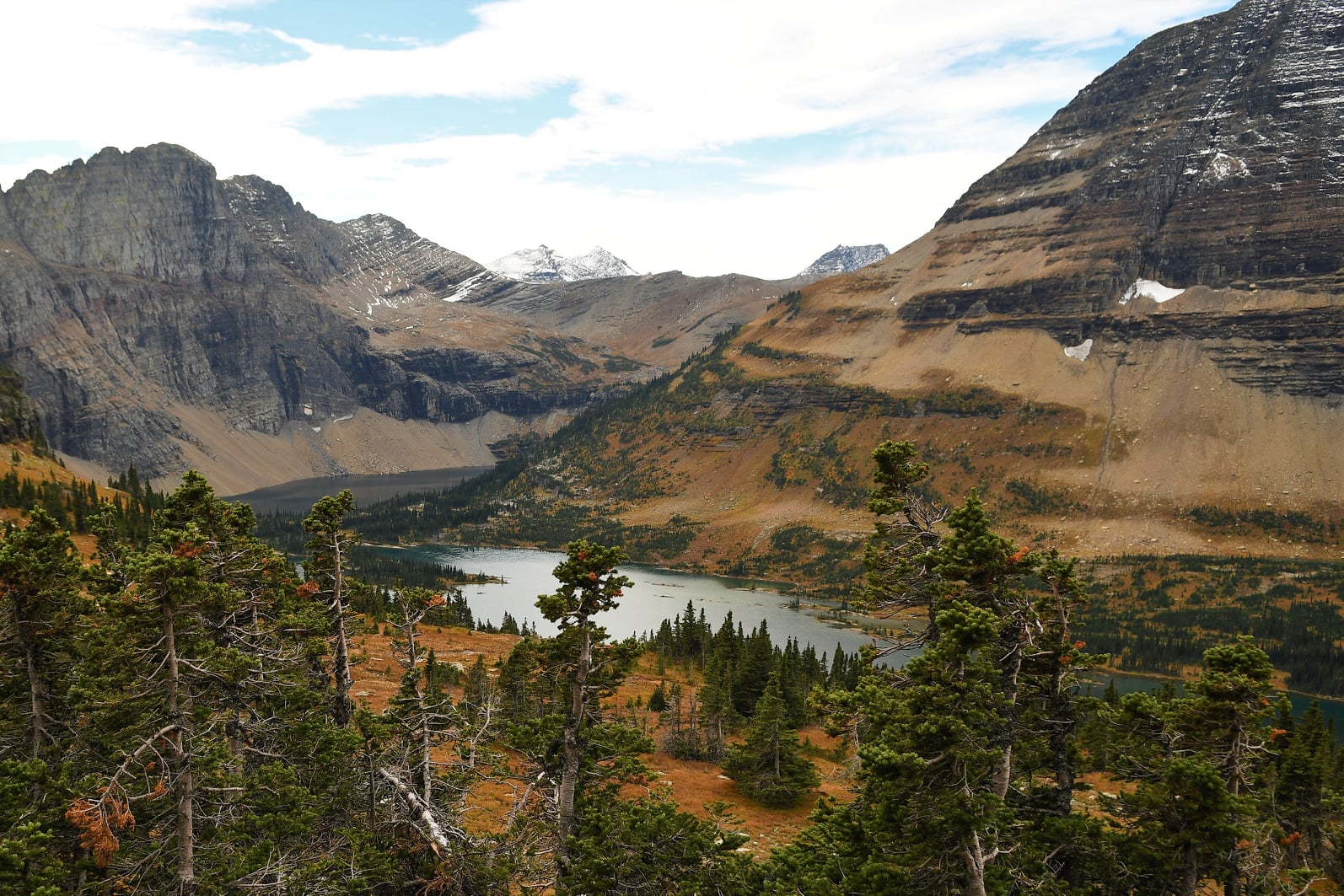
    A cirque is a large bowl formed at the head of a glacier. Often as the ice melts away a small lake will form in the depression gouged by the glacier. Avalanche, Iceberg, and Gunsight are all excellent examples of cirque lakes.

    Hanging Valleys

    Hanging Valleys are found throughout the park. As large glaciers scoured the main valleys, tributary glaciers worked the smaller side canyons. Unable to cut as deep as the valley glaciers, they left behind small valleys high up on the mountainsides. Frequently hanging valleys have waterfalls cascading out of their mouths into the valleys below. Birdwoman Falls, seen from the Going-to-the-Sun Road, plummets from a hanging valley on Mt. Oberlin.

    Horns

    A horn is a steep mountain peak caused by several glaciers carving different sides of the same mountain. Mt. Reynolds at Logan Pass is a good example of a horn.

    Moraines

    Moraines form at the sides and front of a glacier. In a glacier there is always a flow of ice from the head to the toe. This conveyor belt like flow brings with it the rock and debris trapped in the ice. As it reaches the sides or front and the ice melts, this trapped material is released forming large piles. These piles of glacially transported material are called moraines. Moraines from the present glaciers are visible as mounds of rock and gravel along the sides and front of the ice. Plants soon colonize this new soil. Forests and meadows cover many ancient moraines making them harder to spot.


    Wildflowers

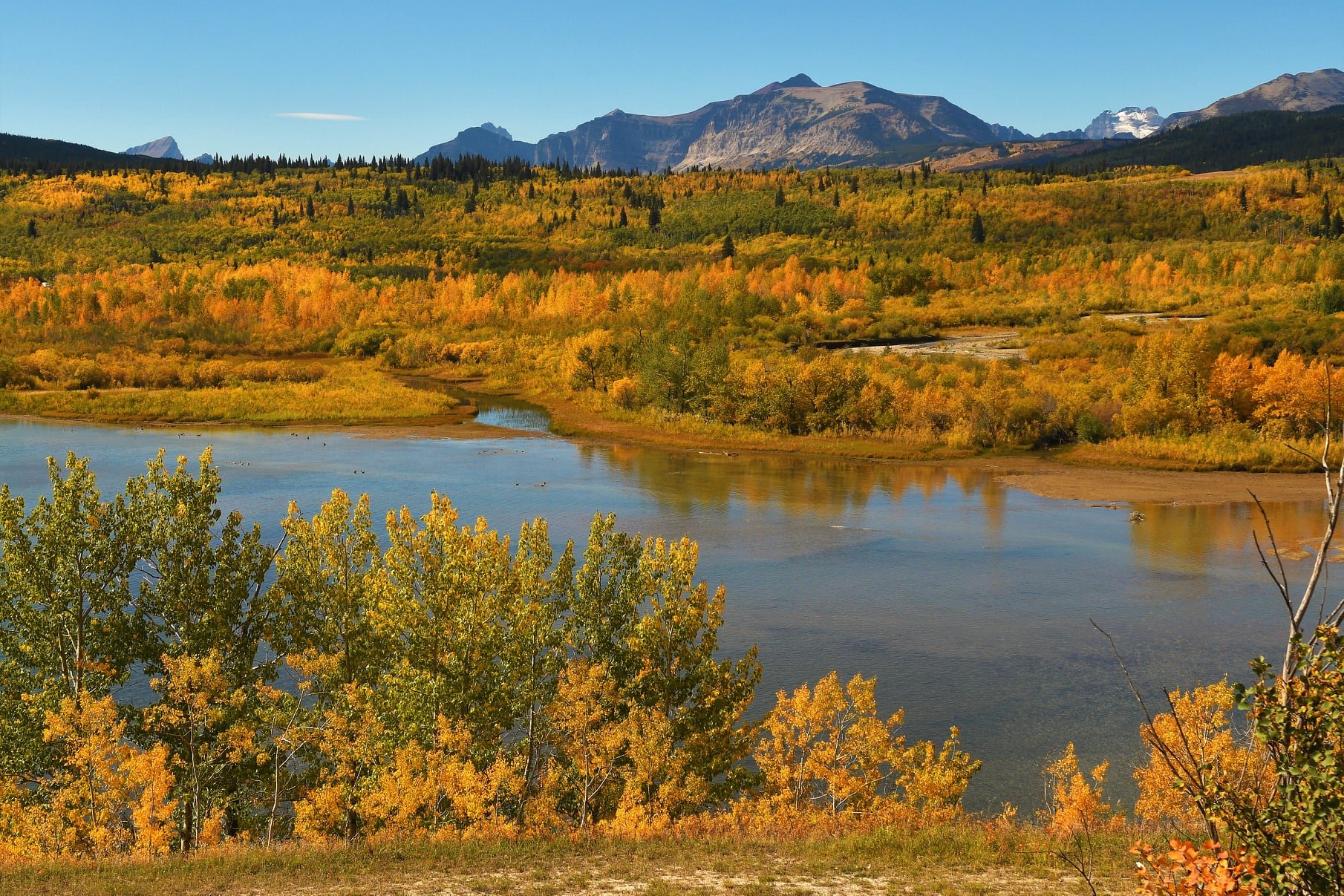
    Today, this landscape is a wilderness full of wildflowers and wildlife with distinct local variations. The high mountains that bisect the park from north to south capture rainfall from the western slopes. This warm, moist Pacific-like environment produces dense forests of larch, spruce, fir, and lodgepole pine. In the Lake McDonald valley, forests of western red cedar and hemlock are common. The alpine areas provide the setting for some of the best wildflower displays in North America. It is a short-lived spectacle made glorious by heather, gentian, beargrass, and glacier lily. East of the divide, where the plains roll up to the mountains, pasque flower, lupine, Indian paintbrush, gaillardia, asters, and shooting stars paint the prairie.


    Wildlife

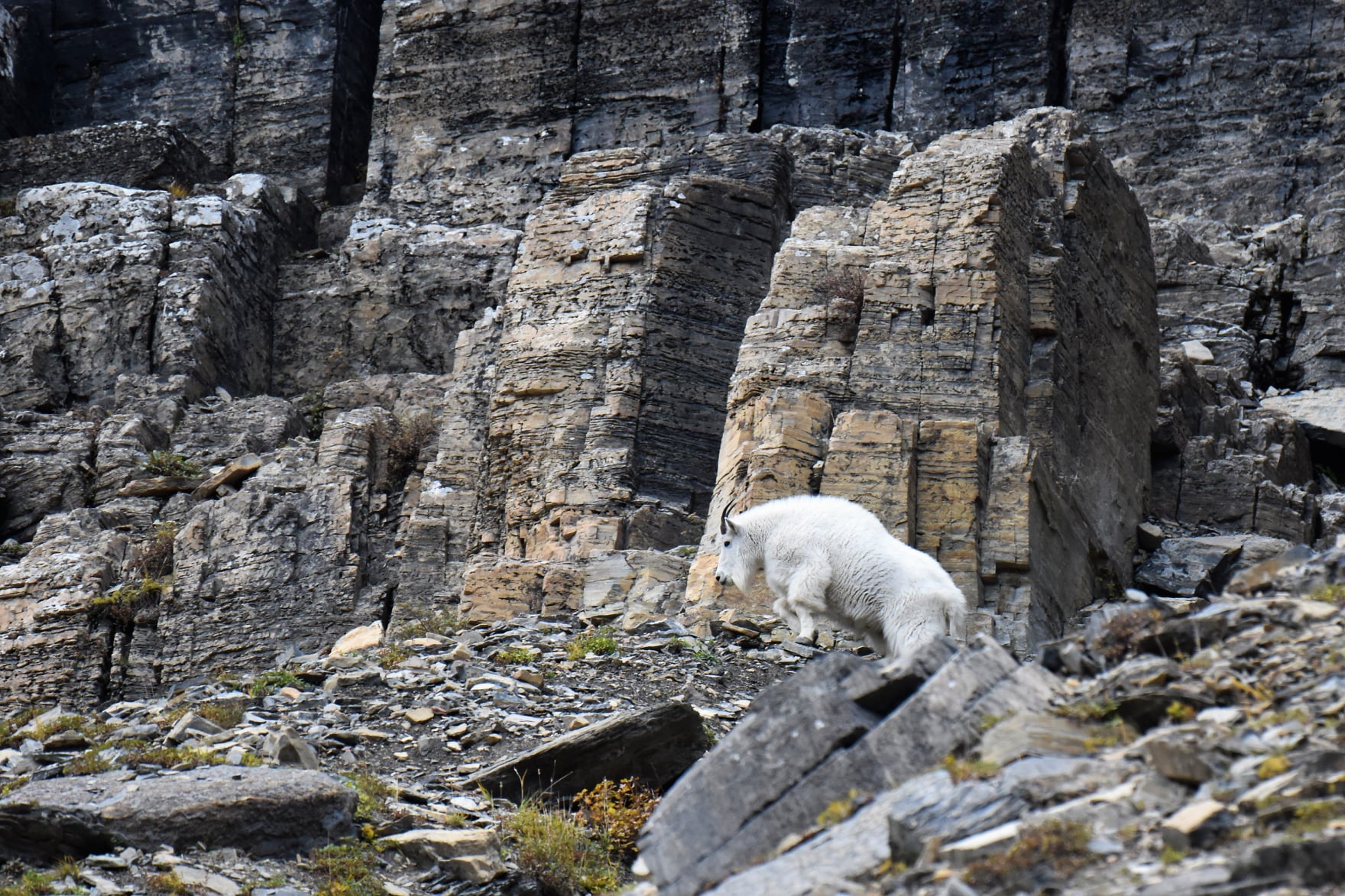
    Big horn sheep, mountain goats, wapiti, (elk), black bear, and whitetail and mule deer are frequently seen. Grizzly bear, moose, wolves and mule deer also live here all year. Waterton Lakes National Park maintains an exhibit herd of bison in a paddock. Beaver, hoary marmot, river otter, marten, and pika make Waterton/Glacier their home. Locally prevalent birds include osprey, ptarmigan, golden eagle, Clark's nutcracker, and Harlequin duck. The endangered bald eagle also nests and fishes here.


    Mammal List of Glacier National Park

    Order Insectivora - Shrewa
    Name Scientific Name Habitat
    Pygmy shrew Sorex hoy Dry, open coniferous forests
    Masked shrew Sorex cinereus Coniferous forests, meadows, ponds and stream edges
    Vagrant shrew Sorex vagrans Moist forests and grasslands, marsh and stream edges
    Montane shrew Sorex monticolus Higher elevation coniferous forests
    Northern water shrew Sorex palustris Stream edges

    Order Chiroptera - Bats
    Little brown bat Myotis lucifugus Coniferous forests, often around buildings, caves, nocturnal
    Long-legged bat Myotis volans Coniferous forests, meadows, nocturnal
    Big brown bat Eptesicus fuscus Coniferous forests, often around buildings, caves, nocturnal
    Silver-haired bat Lasionycteris noctivagans Coniferous forests, meadows, nocturnal
    Hoary bat Lasiurus cinereus Coniferous forests, mostly nocturnal

    Order Carnivora - Carnivores
    Bobcat Lynx rufus Open forests, brushy areas
    Lynx Lynx lynx Coniferous forests
    Mountain lion Felis concolor Coniferous forests
    Raccoon Procyon lotor Open forests, stream bottoms
    Black bear Ursus americanus Forests, slide areas, alpine meadows
    Grizzly bear Ursus arctos Forests, slide areas, alpine meadows
    Red fox Vulpes vulpes Grasslands, open forest
    Coyote Canis latrans Forests, grasslands
    Wolf Canis lupus Coniferous forests
    Striped skunk Mephitis mephitis Open forests, grasslands
    Badger Taxidea taxus Grasslands
    River otter Lontra canadensis Rivers, lakes
    Wolverine Gulo gulo Coniferous forests, alpine meadows
    Least weasel Mustela nivalis Open forests, grasslands
    Short-tailed weasel Mustela erminea Coniferous forests, meadows
    Long-tailed weasel Mustela frenata Open forests, meadows
    Mink Mustela vison Creek and lake edges
    Marten Martes americana Coniferous forests
    Fisher Martes pennanti Coniferous forests

    Order Lagomorpha - Pikas, Rabbits, Hares
    Pika Ochotona princeps Rockslides
    Snowshoe hare Lepus americanus Coniferous forests
    White-tailed jackrabbit Lepus townsendii Grasslands

    Order Rodentia - Rodents
    Porcupine Erethizon dorsatum Coniferous forests
    Beaver Castor canadensis Streams, lakes
    Northern pocket gopher Thomomys talpoides Meadows
    Yellow-bellied marmot Marmota flaviventris Open rocky foothills, talus slopes
    Hoary marmot Marmota caligata Rocky areas, alpine meadows
    Least chipmunk Eutamias minimus High open forests, brushy, rocky areas, alpine meadows
    Yellow pine chipmunk Eutamias amoenus Open forests, brushy, rocky areas
    Red-tailed chipmunk Eutamias ruficaudus Open forest, brushy, rocky areas
    Golden-mantled ground squirrel Spermophilus lateralis High open forests, rocky areas
    Columbian ground squirrel Spermophilus columbianus Open woodlands, grasslands, alpine meadows
    Thirteen-lined ground squirrel Spermophilus tridecemlineatus Grasslands
    Richardson ground squirrel Spermophilus richardsoni Grasslands
    Northern flying squirrel Glaucomys sabrinus Coniferous forests, nocturnal
    Red squirrel Tamiasciurus hudsonicus Coniferous forests
    Western jumping mouse Zapus princeps Grasslands, alpine meadows
    Bushy-tailed wood rat Neotoma cinerea Rocky areas, old buildings
    Deer mouse Peromyscus maniculatus Forests, grasslands, alpine meadows
    Muskrat Ondatra zibethicus Streams, lakes, marshy areas
    Northern bog lemming Synaptomys borealis Coniferous forests
    Red-backed vole Clethrionomys gapperi Coniferous forests
    Montane heather vole Phenacomys intermedius Coniferous forests, alpine meadows
    Water vole Arvicola richardsoni High elevation stream and lake edges
    Long-tailed vole Microtus longicaudus Coniferous forests, grasslands
    Meadow vole Microtus pennsylvanicus Open forests, meadows, along streams, marshy areas

    Order Artiodactyla - Even-toed ungulates
    White-tailed deer Odocoileus virginianus Coniferous forests, meadows, creek and river bottoms
    Mule deer Odocoileus hemionus Open forests, meadows, often at high elevations
    American elk Cervus elaphus Open forests, meadows
    Moose Alces alces Coniferous forests, lakes, slow streams, marshy areas
    Bighorn sheep Ovis canadensis Open mountainous areas
    Mountain goat Oreamnos americanus High peaks and meadows


    Glacier National Park Travel Packets

    Glacier National Park Links
    Bullet Bear Guide
    Bullet Biking Guide
    Bullet Boating Guide
    Bullet Border Crossing
    Bullet Brochures, Maps, Written Info
    Bullet Camping Guide
    Bullet Chat Page
    Bullet Cross Country Skiing Guide
    Bullet Establishment
    Bullet Fishing Guide
    Bullet Geology
    Bullet Hiking Guide
    Bullet History
    Bullet Jobs, SCA, Volunteer Positions
    Bullet Location Guide
    Bullet Lodging Guide
    Bullet Mammal List
    Bullet Map Guide
    Bullet Park Information
    Bullet Pet Information
    Bullet Roads
    Bullet Search
    Bullet Sights Guide
    Bullet Size & Visitation
    Bullet Stock Usage
    Bullet Travel Guide
    Bullet Visitors Guide
    Bullet Weather
    Bullet Wildflowers
    Bullet Wildlife

    Glacier National Park
    Montana /National Parks Back to National Parks
    Equip yourself for your next National Park adventure by visiting our Outdoor Gear and Equipment Store


    by John William Uhler

    Copyright © 1995 - 2007 Hillclimb Media

    Click Here to obtain Advertising Information on this Page

    This site is in no way associated with the United States Government, the Department of the Interior or the National Park Service

    Demand Media Network

    Privacy Policy